Drawing as an architectural laboratory
Zaha Hadid was born in Baghdad in 1950, studied mathematics at the American University of Beirut and architecture at the Architectural Association in London. She established Zaha Hadid Architects in London in 1979. Her early paintings, calligraphic drawings and competition proposals tested fragmented perspectives and continuous fields long before digital modelling made comparable geometries buildable.
From theoretical projects to constructed space
The Vitra Fire Station, completed in 1993, was her first realised building. Later projects including MAXXI in Rome, the London Aquatics Centre and the Heydar Aliyev Centre translated her investigations into circulation, structure and civic space. Curves and directional lines were not applied motifs; they organised movement, programme and visual connection.
An expanded field of design
Hadid’s practice extended from architecture into interiors, furniture, exhibitions and objects, allowing similar spatial ideas to operate at different scales. She received the Pritzker Architecture Prize in 2004 and the RIBA Royal Gold Medal in 2016. Her work continues through the studio she founded and through an archive in which drawing remains central to understanding her design method.
Sources and portrait credit
Biographical sources: Zaha Hadid Architects and The Pritzker Architecture Prize, verified 23 September 2026.
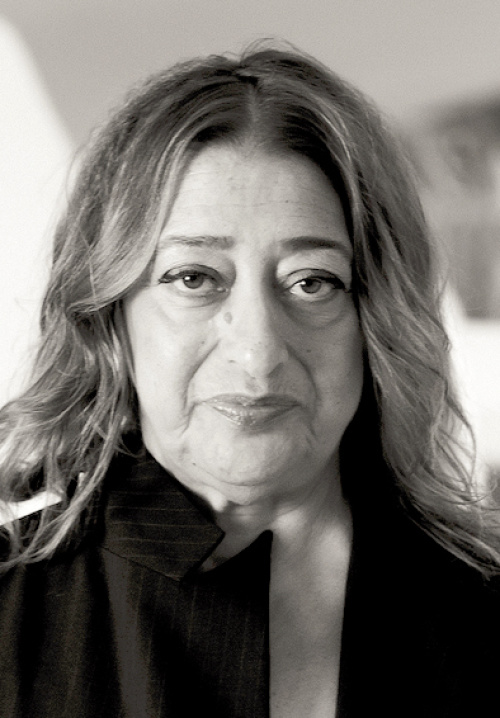
Portrait: Dmitry Ternovoy, via Wikimedia Commons, Free Art License. The image has been reused with attribution.